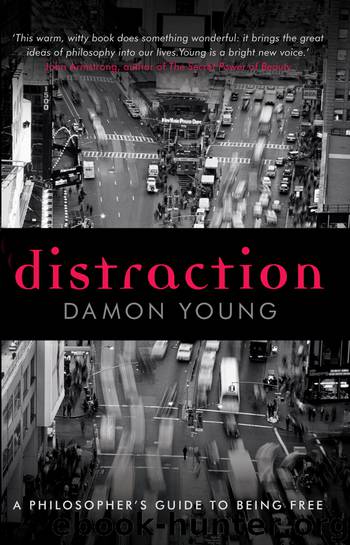
Distraction by Damon Young
Author:Damon Young
Language: eng
Format: epub
ISBN: 9780522859089
Publisher: Melbourne University Publishing
It is not by wearing down into uniformity all that is individual in themselves, but by cultivating it … that human beings become a noble and beautiful object of contemplation; and as the works partake the character of those who do them, by the same process human life becomes rich, diversified, and animating, furnishing more abundant aliment to high thoughts and elevating feelings, and strengthening the tie which binds every individual to the race, by making the race infinitely better worth belonging to.
In passages like these, Mill showed himself to be a man of his liberal age, but an exemplary one. In an age of religion, he was an atheist; of capitalism, a ‘qualified socialist’ (of the utopian sort); and of institutionalised misogyny, a feminist. And while Nietzsche spoke of Mill as a ‘flathead’, no deadened Benthamite caricature could have written with such sensitivity and penetration about landscape and poetry (which was, he told Thomas Carlyle, ‘higher than Logic’).
In his humble, polite English way (what Nietzsche unfairly called the ‘spirit of respectable but mediocre Englishmen’), John Stuart Mill grasped the freedom sought by Bakunin and Seneca, but without their idiosyncratic flaws. In his darkest hours of depression, he felt crushed by the relentless Necessity of fact, circumstance and mechanical cause and effect. However, in his epiphany, he realised that the essence of liberty wasn’t some grand metaphysical purity above these but the earnest practice of self-culture, self-development. ‘What is really inspiriting and ennobling in the doctrine of freewill,’ he wrote, ‘is the conviction that we have real power over the formation of our character.’ In other words, freedom is the invention and application of our own necessities, from our own crooked timber and the chaotic flotsam of the world. And this can’t happen if we are simply chasing our own happiness (either with Bentham’s intellect, or Bakunin’s caprice) or neglecting our emotional life. When Stoics or utilitarians shunned the arts, they were injuring their characters no less than Bakunin, feeding his ‘undisciplined power’ with Beethoven’s Ninth Symphony. By judiciously engaging with good books, conversations, deeds and artworks, Mill revivified Bildung. ‘Human nature,’ he said in On Liberty, ‘is not a machine to be built after a model … but a tree, which requires to grow and develop itself on all sides, according to the tendency of the inward forces which make it a living thing.’
With his living ideal of human flourishing, John Stuart avoided the distractions of Machiavellian statecraft and the allure of private egotism. Instead of simply deferring to the status quo, or blindly railing against it, he concentrated on the sustained and many-sided development of his character. He incorporated the finest aspects of his upbringing and schooling, and judiciously jettisoned others. And as a parliamentarian and outspoken intellectual, this enterprise served him well. But his lasting achievement was not his policies or philosophies but himself. His character was both the means to his enduring public life and an end in itself. Of course we can’t all be John
Download
This site does not store any files on its server. We only index and link to content provided by other sites. Please contact the content providers to delete copyright contents if any and email us, we'll remove relevant links or contents immediately.
| Anthropology | Archaeology |
| Philosophy | Politics & Government |
| Social Sciences | Sociology |
| Women's Studies |
The remains of the day by Kazuo Ishiguro(8941)
Tools of Titans by Timothy Ferriss(8344)
Giovanni's Room by James Baldwin(7291)
The Black Swan by Nassim Nicholas Taleb(7083)
Inner Engineering: A Yogi's Guide to Joy by Sadhguru(6774)
The Way of Zen by Alan W. Watts(6572)
Asking the Right Questions: A Guide to Critical Thinking by M. Neil Browne & Stuart M. Keeley(5733)
The Power of Now: A Guide to Spiritual Enlightenment by Eckhart Tolle(5716)
The Six Wives Of Henry VIII (WOMEN IN HISTORY) by Fraser Antonia(5482)
Astrophysics for People in a Hurry by Neil DeGrasse Tyson(5167)
Housekeeping by Marilynne Robinson(4417)
12 Rules for Life by Jordan B. Peterson(4288)
Double Down (Diary of a Wimpy Kid Book 11) by Jeff Kinney(4252)
The Ethical Slut by Janet W. Hardy(4232)
Skin in the Game by Nassim Nicholas Taleb(4223)
Ikigai by Héctor García & Francesc Miralles(4210)
The Art of Happiness by The Dalai Lama(4112)
Skin in the Game: Hidden Asymmetries in Daily Life by Nassim Nicholas Taleb(3972)
Walking by Henry David Thoreau(3935)
